Delivery #11, Week of August 11, 2025

The News from Windflower Farm

What’s in the vegetable share?

  • Lettuce
  • Swiss chard
  • Tomatoes
  • Peppers
  • Eggplant
  • Onions
  • Parsley
  • Assorted squashes
  • An organic greenhouse cucumber from our friend Andrew Knafle at Clearbrook Farm

We are between plantings of sweet corn. More should arrive in next week’s shares.

The fruit share will consist of Yonder Farm’s plums this week. We’ll be back to their peaches next week. Sorry, the fruit share will be peaches instead of plums this week! 

Thanks again and enjoy!

News from the farm

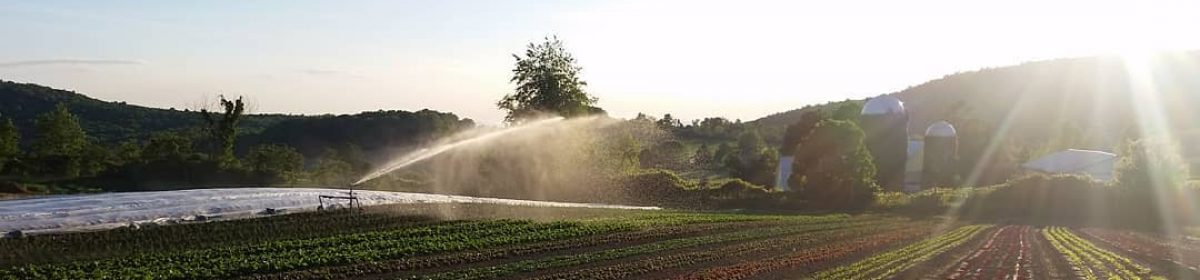
Sunday. I gave up after spending an hour or so reading the NY Times. I have no bandwidth left today for another of the Administration’s abominations. The only news I want today would have rain in the forecast. But search as I might among all three of my weather apps, I could find nothing but hot and dry for the foreseeable future. I water the plants in our greenhouse – the last cucurbits of the season and another round of greens – and then go in search of Nate, who is switching irrigation from lettuces, kale and basil in H2 to sweet corn and Nightshades in H1. These are fields we normally irrigate from the middle pond but, because of the need for water rationing in the north half of the farm, we are irrigating from the barn well. He is fussing with a booster pump he put in place to push water along the final 400’ of pipe.  

Seated at the kitchen table later in the day, I can see Nate in the Front field. He’s seeding with the Sutton Seed Spider, a tool we had shipped to us from the Salinas Valley in California. It is the seeder favored by growers of carrots and spinach. On Nate’s seeding list are arugula, a mix of salad greens, beets and Swiss chard. It’s August, so immediately following seeding he’ll set up some sprinklers. The earth is so parched that we’d get nothing without artificial irrigation. They are accustomed to this out West, but here it is still a part of the new normal of production.

My brother has passed by on a mowing rig, having just cut the grass in the sheep pasture near the barn. The sheep are now in their new summer pasture and appear to be loving it. They are Icelandic sheep and spend the hot part of the day in the shade. If you were to walk by their pasture after dark, however, you’d hear nothing but the tearing of grass and the chomping of sheep’s teeth. I have spotted fox or coyote droppings – I don’t know which – all around the barnyard and in the tunnel in which we are drying onions and garlic, but I have not spotted any of the responsible party. I worry about the chickens, which are nearby, but not the sheep, which are protected by a deer fence and an electrified net fence. Plus, although they might be small, their horns are formidable.

I think of Coastal Maine during the month of August and of lobster and swimming in cold water. To take me there, I’ve been reading Elizabeth Gilbert’s first novel, Stern Men. Remarkably, many if not most early lobstermen didn’t know how to swim.

Hoping you find a way to stay cool this week, Ted

Delivery #10, Week of August 4, 2025

The News from Windflower Farm

What’s in the vegetable share?

  • Sweet peppers
  • Summer squashes
  • Red onions
  • Magenta lettuce
  • Tomatoes
  • Basil
  • Sweet corn
  • Carrots from Denison Farm
  • The fruit share will consist of a pint of our own organically-grown blueberries.

As some of you know, we made a mathematical error recently that resulted in us sending fewer peaches than needed to a couple of CSA sites. Our sincere apologies to you if you missed yours. You will receive make-up peaches this week in addition to the blueberries in your regular share. 

News from the farm

I love sweet corn fresh off the plant and raw and eat quite a bit of it in the field. In this way it’s cool, crunchy and sweet. This first batch is running small because of the lack of rain, but it has most of the qualities that I’m after. So far, I’ve found very few bugs, but that doesn’t mean there aren’t any. A sweet corn tip: because insects get under the corn husk primarily by travelling down the silk channel, they are most often found feeding near the tip of the ear. The best way to deal with the potential problem of finding “worms” in your corn is to cut off about two inches of the ear tip before husking. There isn’t any corn worth eating at the tip anyway. The presence of these insects is difficult to detect, but a quick removal of the tip means you’ll never have to worry about it. Now, if you find a hole in the side of the husk, you are probably dealing with a corn borer, and that’s messier. We make every effort to feed those ears to the chickens, but the holes are sometimes hard to detect, and some will slip through. Insects are interesting, and if you are curious, peel the husk back and find out what’s going on inside.

We are harvesting our storage onions this week. Half the crop spent the week in windrows on the tops of their beds to kickstart the curing process. We’ll place these in crates and tuck them in the greenhouse to complete curing. Today, we are pulling the second half of the crop and will leave them in windrows for the next several days. Field drying like this shrinks the onion’s neck tissue and can stop or slow the spread of any disease from leaves to bulbs. The hailstorm that took place here three weeks ago mowed the tops off most of our onions. Unfortunately, they hadn’t quite attained their full size, but they are still good, and we are sending some of the red ones this week in bunched form.  

Have a great week, Ted

Delivery #9, Week of July 28, 2025

The News from Windflower Farm 

What’s in the vegetable share?

  • Eggplant
  • Summer squashes
  • Yellow onions
  • Tomatoes
  • Basil
  • Fennel
  • Sweet corn
  • Bunched beets from Denison Farm
  • Lettuce from Denison Farm

The fruit share will consist of a quart of peaches from Yonder Farm.

The first of our sweet corn is coming this week. There is some bug damage in the tips. You may want to cut off the tips before shucking your corn. 

News from the farm

The water level in our primary irrigation pond, which is in a deep ravine in the middle of our farm, has been going down during these hot and dry weeks of midsummer, concentrating the aquatic wildlife in an ever-smaller pool, as happens every year at this time. The snapping turtles, fishes, frogs, and insects have come to reside in what I imagine is uncomfortable proximity. Nate and I were installing a dock on which to relocate an irrigation pump in a corner of the pond the other day when we encountered the remains of a crawdad that measured a whopping 7 ½ inches in length. Tracks in the mud suggested that the animal may have been mortally wounded by a racoon, a species known to relish crayfish. I once had crayfish at the Bobcat Café, in Bristol, Vermont, in a dish called prawns in marinara with linguine, and found them to be surprisingly good.

We were admiring the creature when Jan came running down the pond trail in pursuit by the county sheriff. “What had she done?” I wondered. “Are you OK?” she asked. It took us a minute to understand what was going on. It turns out that Nate had butt-dialed 9-1-1. The sheriff was surprised at how difficult it was to keep up with Jan, who first ran down a steep hill and then up another long one before getting to us. But I wasn’t – she was a track star in high school. He gets butt dials all the time, he said, and must respond to each one. He’s been to almost every farm in the county. The sheriff also said that Candelaria and Salvador, who are part of our Mexican staff, looked nervous when they saw him go by. “No kidding!” I thought.

After nearly an inch of rainfall today, the pond’s level has risen considerably, and its inhabitants are no doubt happy to have a little more space. And Nate is happy to have a break from irrigation this week.

Have a great week, Ted

Delivery #8, Week of July 21, 2025

The News from Windflower Farm

What’s in the vegetable share?

  • Tomatoes
  • Basil
  • Beets
  • Fennel
  • Kale OR Chard from Denison Farm (your choice)
  • Lettuce
  • Cucumbers
  • Onions
  • Beans

Everything in your share was grown organically at Windflower Farm except for the kale and chard, which were grown organically by our neighbors at the Denison Farm. What’s coming soon from our fields? Sweet corn, sweet peppers and beans. Your fruit share will be a  quart of Yonder’s peaches.

News from the farm

Nate is using the Bezzerides Spyders today. His goal is to get through the last two plantings of corn, the second succession of beans and all the leeks. It’s an old-school tool made of steel fingers instead of the plastic that is more common with today’s cultivating equipment. It destroys weeds and gently hills the crop. If you were lucky enough as a kid to have a bike with a whirling pinwheel on the handlebar, you’d have a sense of the Spyder. Imagine making a pinwheel out of steel, turning it upside down, hanging it from the belly of a tractor, and dragging it through the soil. Now picture four of them in a gang, two for each crop row. You’d be pleasantly surprised by the result.

In Nate’s case, the Spyders are mounted on the belly of the latest of our electric tractors. This one is our ‘Ultralight’, made 750 lb lighter than our previous model by switching from lead-acid to lithium batteries and using a narrower gauge of steel in the wheels. We’ve also been using it with lighter weight implements. We had been breaking axles, which is not good, and needed to lessen the tractor’s torque requirements. So far, so good. Still, we are on the hunt for a more robust axle. We don’t want to have to pamper our equipment. To that end, we’ve begun working with a new producer of heavy-duty electric axles in Italy (unfortunately, this is just in time for Trump’s 40% tariff on everything coming from the EU). My search for a US-made axle has not been successful.

The team rallied last week in the wake of our hailstorm. We mowed ruined crops or turned them under, transplanted everything that was on-deck in the greenhouse, weeded greens that we might otherwise have let go, and stepped-up irrigation. Nevertheless, the impact of the storm will continue to be felt for a few weeks. Good news: last week’s Department of Agriculture and Markets produce safety inspection resulted in an A rating.  

On Saturday, after watering plants in the greenhouse, we put canoes on the Toyota pickup and headed to Boreas Pond Wilderness. Paddling among the loons, swimming in an Adirondack Lake, and relaxing with my family against the backdrop of the high peaks was just the thing for this tired old farmer.   

Have a great week, Ted 

Delivery #5, Week of June 23, 2025

The News from Windflower Farm

Reminder: there will be no delivery next week. We will resume CSA deliveries during the week of July 7th with delivery #6.

What’s in the vegetable share?

  • Green oakleaf lettuce
  • Romaine lettuce
  • Purple kohlrabi
  • Red radishes
  • Summer squashes
  • Cucumbers
  • Napa cabbage or choy (from Dension Farm)
  • Red Russian kale
  • Garlic scapes
  • Onions

Lettuce and kale fare poorly in high temperatures. To preserve them, rinse them with cold water when you get home, spin or shake dry and store them cold.   

The fruit share is a quart of Yonder Farm’s strawberries.

News from the farm

Warm season crops are beginning to come in with the arrival of summer and the season’s first heat wave. Cucumbers and squashes are starting, but quantities are limited. It’s my hope that when deliveries resume after the July Fourth weekend, we’ll have an abundance of both. One of our projects during the delivery hiatus is to transplant our second succession of these two vegetables. Experience has taught us that three or four plantings of squash, separated by a month or so, is sufficient to maintain a supply for the season. As one planting goes down, usually because of powdery mildew or another disease, the next kicks in.

Cucumbers are more difficult for us. They are susceptible to everything that infects squashes, and they are susceptible to downy mildew, which is virulent enough to cause a complete loss. New to this year’s crop plan is the addition of two varieties of cucumber with a degree of downy mildew resistance. Plant breeders have so far had success developing resistance in pickling varieties, adding two weeks to the harvest window. If all goes well, you’ll find these picklers in your shares later in the season.

Plans for the week include hand weeding the bare ground onions and herbs in what we’ve come to call the Woods Field, transplanting a block of sweet corn, seeding green and yellow wax beans, staking and trellising the sweet peppers, and buzzing all over the farm with our electric cultivators.

Other plans for the week ahead include moving Nate’s sheep to a new pasture, covering the blueberries with insect/bird netting and weeding the rest of the farm. And, time permitting, going paddling in the Adirondacks.

Be careful out there this week – it’s going to be hot!

Have a great Fourth of July, Ted