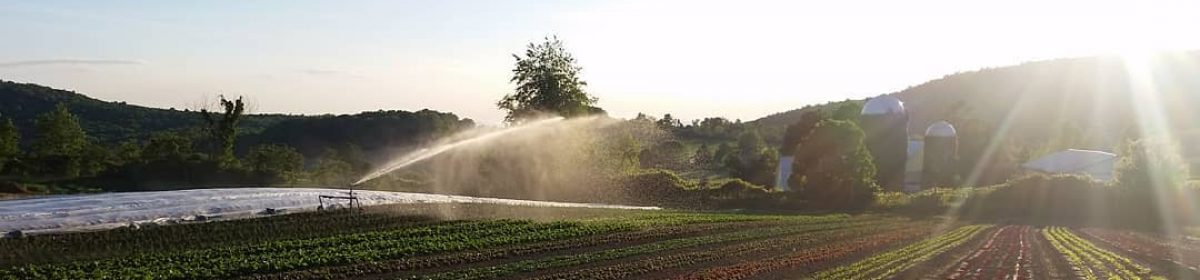
Week of July 18, Distribution #7

The News from Windflower Farm

What’s in your share?

  • Green leaf lettuce
  • Spinach
  • Squashes
  • Tomatoes
  • Radishes
  • Beets
  • Red onions
  • Garlic scapes
  • Your fruit share will be one quart of peaches. 

During the winter, we arranged with a friend who farms some bottom land along the Tomhannock Creek to grow carrots for us in exchange for the onions and shallots we would grow for him. His is the better farm during dry years, and so it was a hedge against risk. His carrots will be making their way into your shares soon. Our bell peppers and new red potatoes and an arugula planting will also be coming along shortly.

What’s new on the farm

“We’re all Californians now,” said Pete, the fruit farmer we work most closely with. His neighbors have been complaining because he has drawn his irrigation pond so low that it has begun to stink. That can’t be pleasant, but what’s a farmer to do?

Our ponds are empty now, too. Which is to say that we’ve taken them down as low as we are willing to go. It’s necessary to leave some for the wildlife that has come to depend on them. I am curious about the Great Blue heron that travels from pond to pond in our neighborhood. I wonder how the hunting compares to last year when water levels were high. They are an adaptable species. During a particularly wet season a few years ago, a heron would regularly hunt frogs in our flooded back lawn.

Nate and I took a day off yesterday and headed up to Lake Champlain, where we keep an old sailboat. It is a deep lake, and a dip in the water was cold and refreshing. Along the way, the corn crops we saw were spikey and dry, and the soybeans were stunted and wilting. We are not alone in this: much of northern New England is in a severe drought.      

We had 12 inches of rain last July. We have not had our first inch so far this July. The weather map shows a storm the size of the state of New York headed our way. But we are on its very southern edge and its trajectory does not look promising. It is sprinkling now, and I am trying to be positive. This is when we find out just how superstitious we might be. We don’t want to say or think anything that would jinx our chances. Hiliberto says “it is what it is,” which I find hard to argue with but not especially satisfying.

Fear not – vegetable production at Windflower Farm will not grind to a halt. The new pump in the Hill Field well is working well, and last week’s delivery of thousands of feet of new line is redistributing the water from our primary well to those corners of the farm that were previously served by our ponds. We’ll get through this, and we’ll be better prepared for the next dry spell.

Have a great week, Ted

Week of July 11, Distribution #6

The News from Windflower Farm

What’s in your share?

  • Tomatoes
  • Greenleaf lettuce
  • Swiss chard
  • ‘Caraflex’ (pointy green) or ‘Tendersweet’ (round green) cabbage
  • Assorted squashes
  • Cucumbers
  • Japanese turnips
  • Garlic scapes 
  • Yellow onions

Beets and spinach and red onions will come next week. Peppers should be coming soon. Your fruit share will consist of fresh blueberries from Yonder Farm. 

What’s new on the farm

I’ve just weeded our first four beds of eggplants out of a total of eight. They were not especially weedy, but I wanted to deal with the situation before things got out of hand. If I’m feeling ambitious, I’ll weed the other four tomorrow. But weeding can be tough on the lower back, and tomorrow may come a little too soon. The eggplants comprise a quarter acre of garden in total. They are all on drip irrigation and poly mulch and make for a tidy planting. There are perhaps half a dozen varieties in all, including the Pingtung Long that I weeded today and another slender Asian type, two or three bell-shaped Italian varieties and a couple of stripped and neon novelties. They are just beginning to fruit, and it will be a few weeks before they are in shares. The weed species were the usual suspects: pigweed, lambsquarters, Galinsoga, barnyard grass, lady’s thumb and purslane.

As I weeded and listened to the irrigation water gurgle under the mulch, I witnessed one of life’s small dramas unfold in the eggplant canopy. The lambsquarters were loaded with aphids, and the eggplants (and many weeds) were loaded with ladybugs (or ladybird beetles to be more precise). The progeny of a ladybug is often called an aphid lion (lacewing larvae also go by that name), and this is where things became dramatic: the aphid lions were in hot pursuit of their prey – the aphids on the lambsquarters. Interestingly, I couldn’t find any aphids on our eggplants. When I think about it, we almost never have aphid problems on our vegetables, and I think it’s because of a healthy resident population of ladybugs and lacewings, which appear to be our farm’s insect invasion quick response team. Oddly, the adult ladybugs play no direct role in this deadly game – they are bystanders who watch as their offspring pounce on their prey.

We have been irrigating around the clock, which has kept our vegetables in good shape, but has also exhausted our water resources. I called a well driller last Thursday, and today, Sunday, he installed a new pump at the bottom of a new well, some 360’ below grade. Tomorrow, we’ll be pumping even more water. This has been our driest spring and early summer ever, and our ponds have become dangerously close to empty. We’ve been close before, but never this close. This newest well should take care of four to six acres of vegetables and should take the edge off. One indication of how dry it has become is that the lawn has died back. Any green that can be found now is not grass but dandelion, lance leaf plantain, yarrow, white clover and mallow, all tap rooted plants that can mine the deeper reaches of the soil profile. Another indicator is the state of our two irrigation ponds – which are discouragingly low. All the ponds’ inhabitants have become concentrated in what little space remains watery. Predator and prey species are now uncomfortably close. Water striders are living cheek by jowl with pond frogs, their beady compound eyes intensely focused on those dangerously long frog tongues.

Have a great week, Ted

Week of July 4, Distribution #5

The News from Windflower Farm

What’s in your share?

  • Red Butterhead lettuce (2 heads)
  • Assorted kales  (1 bunch)
  • Squashes (4)
  • Cucumbers (3)
  • Broccoli (1 bunch)
  • Japanese turnips (1 bunch)
  • Garlic scapes (1 bunch)
  • Yellow onions (1 bunch)

Beets and cabbages and Swiss chard should come next week. Your fruit share will consist of sweet cherries from Yonder Farm.

What’s new on the farm

Most of the tomatoes are now as tall as I am. Their names sound a bit contrived, gimmicky, like stage names: Supernova, Plum Perfect, Gin Fizz, Lucky Tiger, Five Star, Enroza, Big Beef, Grandero, Valentine, Cuba Libre. The marketing people are trying to sell a new generation of tomatoes to a new generation of farmers. The workhorses of the group – Abigail, Rebelski, Clementine – sound modest by comparison. The grape tomato called Supernova is getting started. So far there are only handfuls. It is so named because it’s the red orange of fire streaked with yellow, and it’s sweet and tomatoey and explodes in my mouth. It is hard to wait, isn’t it?

Oh, say, can you see? At night it is dark enough here that the lightning bug’s bioluminescence makes a terrific display, a poor man’s fireworks. Late at night in Nate’s elderberry field, from which not one artificial light can be seen, the on and off flashes of thousands of lightning bugs are a spectacle. The aesthetics of farming have appealed to me for as long as I can remember. As a kid in Illinois, it was the imprint of rolling fields of corn and soybeans, interspersed with hog pastures and their farrowing huts. In New Jersey, it was the cut flower farm up the road from my parent’s house, with its colorful rows of zinnias and sunflowers that caught my eye. On the market farms outside of Boston where I attended college it was the neat rows of cabbages and lettuces and carrots and the lovely farm stands. Here at our farm, it’s the uniform rows of potatoes and beets and onions, especially when we’ve managed to keep them free of weeds. It’s staked and trellised peppers, straw mulched beds of winter squashes, the view of a multicolored lettuce field from a height of land, pruned tomatoes in a spiral as they climb a string, cover crops of oats and peas with purple blossoms, and rows of crops on the contour, gentle curves following a sloping landscape.

Happy Fourth of July, Ted

Week of June 27, Distribution #4

The News from Windflower Farm 

What’s in your share?

  • Arugula
  • Bok Choy
  • Red Butterhead or Red Oakleaf lettuce
  • Red radishes
  • Sweet Japanese turnips
  • Garlic scapes
  • Broccoli
  • Summer squash or zucchini
  • Cucumbers
  • Potted Genovese basil

Your fruit share will consist of sweet cherries from Yonder Farm. Our cucumbers are getting started and will be in shares soon. Tomatoes are green and plump and thinking about turning red but waiting for that to happen is like watching the proverbial pot of water come to a boil. I understand that garlic scapes can become tiresome, but they make for a good pesto. And each scape represents a future garlic bulb. Arugula can also be turned into a good pesto.

Our packaging is undergoing a transition. In our packing shed, we continue to juggle every manner of container, but we are working closely with site coordinators in your neighborhood to shift back to pre-pandemic packing. Please bear with us.

What’s new on the farm

The rain has just stopped, and the barnyard is full of puddles. If I take an average of what the rain gauges scattered around the house tell me, and they vary widely, we got 6/10s of an inch. Whatever it was, it was very welcome. It had been three weeks since our last rain and the land had become parched. Irrigation had become full-time employment. I recall being told that a vegetable farm needs an inch and a half every week to achieve good yields. I rest easier knowing that for this week we are already halfway there.

The packing shed is busy this morning. The harvest has been completed and now the work of washing, sorting and packing has begun. Victoria and Daren are our packing and distribution co-coordinators and, between the two of them, have over 30 years of experience. I tell new employees that it’s never too early to develop an exit strategy. I kid, of course. Six members of our staff have been with us for 15 years or more – a fact that gives me a good deal of satisfaction. Victoria and Daren have three helpers today, all high schoolers from the neighborhood – Abe, Charlie and newcomer Ezden. Their day will be spent first in building boxes and washing and sterilizing shipping tubs and then in washing and packing the eight or nine items that will go into tomorrow’s shares. It’s work that will take the five of them well into the afternoon to complete. I don’t spend a lot of time in the packing shed – my work is in the field – but Victoria and Daren must make it enjoyable. Whenever I do go in, there is laughter or an interesting conversation. And people keep coming back.

Have a great week, Ted 

Week of June 20, Distribution #3

The News From Windflower Farm

What’s in your share?

  • Mixed salad greens, bunched
  • Romaine lettuce
  • Lacinato kale
  • Purple kohlrabi
  • Red radishes
  • Bunching onions
  • Garlic scapes
  • Broccoli
  • Summer squash or zucchini

Some of the lettuce has become oddly elongated because it was growing in a weedy bed. You might pluck the leaves from the stem for a better eating experience. Your fruit share will be Yonder Farm’s sweet cherries.

What’s new on the farm

The more I pay attention, the more I realize that every growing season is strange. It’s the extremes of hot and cold that make this one noteworthy. Over the weekend we travelled back to early April weather, and today we have returned to a seasonable 80 degrees. The early warmth of May explains why our Happy Rich and bok choy bolted early and our strawberries came and went before our first CSA distribution (fruit share members have been getting Yonder Farm’s strawberries, which are a later variety than ours). I’m not yet sure what this weekend’s cold temperatures will bring, but I imagine it was fine for our greens and broccoli and likely a setback for our cucumbers and other warm season crops. Risk mitigation is large part of my job description. Growing a variety of crops is one strategy – we include some vegetables in our crop mix that are happy with hot weather (zucchini, chilis, sweet potatoes) and others that want the cold (lettuce, arugula, Swiss chard, kale). And a second strategy calls for plastic-covered greenhouses and caterpillar tunnels and spun polyester fabrics to cover such sensitive crops as peppers, tomatoes, ginger and basil. I was weeding in a pepper tunnel during yesterday’s cold blast and it was like taking a short excursion to North Carolina.

An article in July’s Scientific American called “Thirsty Air” described something that farmers already know – more rainfall (or irrigation) is required in a warming world in order to keep up with increased evaporation and plant transpiration. In the Southwest, that means 8 to 15% more; here in the Northeast it is less dramatic, at least in a humid year. In a year like this one, when we are experiencing a rainfall deficit of several inches, low humidity and high winds, a good deal of our energy goes into irrigation. We spend our time powering up pumps and hauling sprinklers and reels of drip tape around the farm. Nate maintains an irrigation schedule on a simple spreadsheet. Our entire farm is covered by at least one of three irrigation sources and sometimes all three can be running at once.

Most strategies deployed to mitigate risk require material inputs – especially plastics and fossil fuels. This year, because we can’t stand the stuff, we’ve greatly reduced our use of plastic mulches, confining them to those warm-loving crops that simply would not perform without them. And we’ve moved away from overhead (or sprinkler) irrigation in favor of water-conserving drip irrigation and reusable drip tape. But conservation often comes with its own costs: less mulch means more weeding, and more drip irrigation can result in more plastic waste unless a way is found to pick the tape up so that it can be reused. To address the increased weeding chore, we’ve added specialized cultivating tractors to our small fleet. And to facilitate the reuse of drip tape, we’ve purchased a tool that rolls it onto a spool at the end of a season and built another that lays it out again at the beginning of the next season. Finding good answers to these production challenges is part of what it means to farm well. 

Have a great week, Ted