Distribution #5, week of June 26

The News from Windflower Farm

I’d like to wish everyone a happy Fourth of July in advance of the holiday.

What you’ll get this week

  • Red butterhead lettuce
  • Green or red oakleaf lettuce
  • Arugula
  • ‘Joi Choy’
  • ‘French Breakfast’ radishes
  • Garlic scapes (8)
  • ‘Boro’ beets
  • Cucumbers
  • Summer squash or zucchini

The fruit share will be Yonder Farm’s strawberries and rhubarb.

News from the farm

I’ve escaped chores for the past two days, so, today, it was my turn to clean the outhouses and water plants.

It’s been a rainy Saturday ahead of what is expected to be a wet week. After a walk around the farm to produce the week’s harvest and to-do lists (string tomatoes and peppers and weed, weed, weed!), I’ve headed into the workshop. Four small projects are on deck. The first is to make more of our mini pallets (under the new Food Safety Modernization Act, crates brought from the field to the packing shed may never touch the floor), the second is to make a tractor mount for an old basket weeder we’ve had laying around, the third is to install a solar battery charger on the roof of a cultivating tractor, and the fourth is to clear my things out of the shop – the tomato harvest will soon require that space! All are rainy weather projects. I think that Nate will help me.

Basket weeders are old-school weeding technology dating to the 1940s, before the widespread adoption of herbicides. They were designed for direct-seeded vegetables like carrots and beets and only continue to be used by organic growers. Picture a five-foot-long axle on which five rolling baskets that look like hamster cages are mounted. Now picture two such axles arranged in parallel so that eachbasket on the front axle has a partner aligned directly behind it. The axles are linked by a chain and sprockets, and the whole apparatus is held together by means of a simple frame. Both baskets roll across the ground, but the rear one rotates a bit more slowly than the one in front because its drive sprocket is larger. As a result, the rear basket effectively skids across the ground, thereby uprooting any little weeds in its path. There are gaps between the five pairs of baskets, so that the four rows of vegetables are left unmolested. There was a time when virtually every vegetable farm in America had one of these, but now most are rusting in their hedgerows.

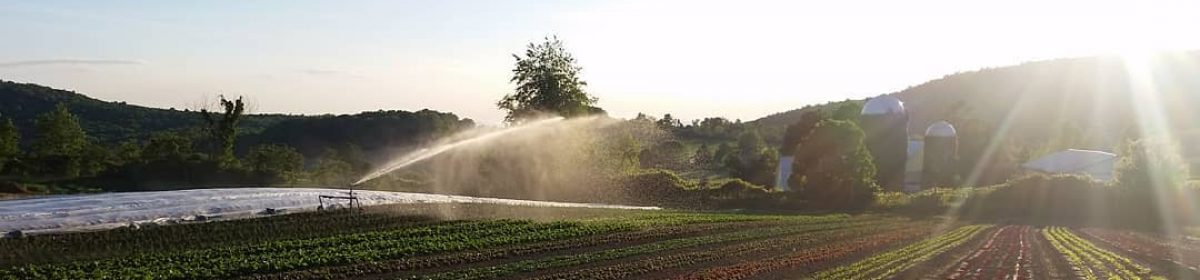
Today’s rain has moved off to the north and east, the sun has set, and a crescent moon and stars can be seen to the west. The big dipper has just emerged from behind remnant clouds. The crickets are noisy, and the fireflies fill the back lawn with their blinking lights, some shooting straight up and into the night sky like so many comets. I checked the rain gauge: 9/10 inches. No need to irrigate this week.Instead, we’ll work in the tunnels, catching up on our tomato stringing and pepper trellising.

Have a great week, Ted

Distribution #4, week of June 19

The News from Windflower Farm

It’s grain and maple share week! If you’ve ordered either, be sure to get them.

Rain has come, and sunshine and heat are coming. Finally, the arrival of summer. Cucumbers, zucchini and yellow squashes are starting, and at least one of them will make it to you this week.

What you’ll get this week

  • Green butterhead lettuce, a variety called ‘Nancy’
  • Bok Choy
  • Kohlrabi
  • Hakurei turnips, a sweet Japanese variety
  • Mixed kales
  • Garlic scapes (5)
  • Cucumbers or summer squash

The fruit share will be our own organically grown strawberries along with Yonder Farm’s rhubarb.

News from the farm

Young Charlie walked in the door just before 8:00 this morning. You could hear him coming all the way from his house in his well-used Ford pickup. It was music to my ears. School is out for the summer, and it’s his first day at work. Charlie’s presence makes it possible for both Nate and me to be out on the farm today, Nate to cultivate and me to prepare beds for the next plantings of sweet corn, lettuce, cabbage, and other odds and ends.

Nate is juggling three tractors today. He’s using the John Deere 5425 and a Checchi-Magli hilling set in sweet corn, potatoes and leeks. He’s got the Duos (small discs) on the G tractor. They are for the direct seeded crops that have just emerged along with a flush of new weeds. And he’s got the Steketees (a collection of five sweeps) set up on the electric blue tractor. It’s for onions, beets, greens, and herbs. His goal is to get through the whole farm every week or two.   

Charlie is a high schooler from next door and in his second season with us. His sister worked for us for a couple of summers, and now, unbelievably, she has graduated from college and is already a nurse on her way to becoming a physician’s assistant. His little brother Brady will join us beginning next week. And I hope that Ezden and Kaitlin, kids from two other nearby families, will also be joining us shortly. If the moms or dads in the neighborhood want to know where their kids are, they might start here.

It’s safe now to remove the covers from our collards, cabbages, broccoli and even our bok choy. The flea beetles that the covers are intended to protect these crops from prefer younger, more tender plants like arugula. When we first put the covers on the beds, the plants are small, and the cover lies nearly flat on the ground. Over time, the developing crop pushes the cover up, sometimes, quite high. It was our hope today that what was pushing the covers up was all crop, but we were met with a surprise: a mix of pigweed, lambsquarters, lady’s purse, Galinsoga, and a few other invaders. And so there will be some hands-and-knees weeding, which is not our favorite way to deal with weeds, but it’s OK. The rain has made it easy to pull weeds, the weather is comfortable, and we have a full crew, the many hands that will make light work of the project. 

Have a great week, Ted

Distribution #3, week of June 12

The News from Windflower Farm

It rained! A total of an inch of rain fell over the course of three or four days last week, giving the irrigation team a chance to turn their attention to cultivation. Our two electric cultivating tractors have seen a fair amount of action so far this spring, and things don’t look bad. One is set up to tackle the weeds in direct-seeded crops like radishes, beets, and arugula. The other is set up for transplants – thelettuces, kales and cabbages in our crop mix. A third electric tractor is in the final stages of its build. We haven’t committed it to a function yet. We might use it to seed or to spray or to weed something specific, such as the pathways between mulched beds or hilled crops like potatoes, leeks and corn. Or we might turn it into a transplanter. If we are to realize the goal of reducing diesel fuel consumption on the farm, we should probably focus on transplanting – our biggest user of fuel.    

What you’ll get this week

  • Yellow onions, bunched
  • Green oakleaf lettuce
  • Bok Choy
  • Red radishes, bunched
  • Garlic Scapes
  • Mixed kales, bunched
  • Chard, bunched
  • The fruit share will be strawberries from Yonder Farm.

News from the farm

Last week, we were asked how we deal with waste. Like most businesses, we generate too much of it. It’s a big topic, but plastics clearly top the list. Here are a few things we’ve been doing to address waste on our farm. We use the three Rs, of course. In the Reduce category,we have been working to eliminate our use of black plastic mulch – a standard in vegetable farming. We have eliminated mulch in all but our first Cucurbits, our few field-grown Nightshades, and our sweet potatoes. Next year, we’ll focus on alternatives to plastics in sweet potatoes. In our return to tubs at most of our sites, we’ve significantly reduced our use of boxes and plastic inserts. When we’ve purchased compost, we’ve transitioned from small plastic compost bags to durable supersacks (1 sack equals 40 bags). Beyond plastics, it was a pleasant surprise to find that our new delivery truck uses perhaps 20 percent less diesel than our old one. And in our transition to more and more drip irrigation, we’ve significantly reduced our water consumption (but we’ve used more drip tape).

In the Reuse category, we have been using much of last year’s drip tape again this year, thanks to a small retrieval tool made by Nate. We’ve also reused most of last year’s row cover, and all of last year’s tubs. And we’ve reused the plastic on many of our greenhouses for so long that there is a risk of some of it blowing off in the next wind. We Recycle, too, of course. Spent boxes, for example, go to thetransfer station (although I have no idea what becomes of them afterwards). Spent pallets become the fuel that heats our winter workshop. And vegetable waste is recycled by composting it first, and then spreading it on the farm. We still have work to do, but we’re working on it!

Have a great week, Ted

Distribution #2, Week of June 5

The News from Windflower Farm

Last week was hot and dry. Irrigation went on around the clock, making use of all three wells and one of two ponds. To conserve water, we applied drip irrigation tape to all our sweet corn, onions, leeks, shallots and beets, crops that would ordinarily have been overhead or sprinkler irrigated. Our first beans have germinated well and are ready for their first cultivation. We cultivated (meaning weeded by tractor) the greens, onions and potatoes. The only weedy patches now are where we’ve just pulled covers off our broccoli and cabbage. We directly sowed beds of arugula, spinach, radishes, dill and cilantro. We planted second successions of sweet corn, cucumbers and zucchinis. Sweet potato slips arrived on Friday from North Carolina and planting them along with the young winter squash plants growing in our greenhouse will be a focus of the week ahead. There’s a large, nearly full moon out tonight. I’d call it a Planter’s Moon if it were up to me. The black locusts have begun to bloom and it’s safe to plant your garden.

What you’ll get this week

  • Green Romaine lettuce
  • Red oakleaf lettuce
  • Red radishes, bunched
  • Kohlrabi bulbs
  • Assorted kales, bunched
  • Genovese basil, potted
  • The fruit share will be our own ‘Chandler’ strawberries on Tuesday and either our strawberries or Yonder Farm’s on Thursday.  

News from the farm

A truck farm needs a delivery truck. Our lease with Penske expired in January, and it became time for something new. We decided to purchase rather than to lease, and the truck we selected is a diesel Isuzu NRR. Its box is six feet shorter and its cab, being of the stub nose variety, is perhaps four feet shorter than our last truck, shortening the whole package by a whopping ten feet. This was happy news to Don and Daniel, our drivers, who must navigate the congested streets of New York City twice a week. Every bit as important to the task of ducking around double-parked cars and trucks is that its insulated box is 6” narrower than the old one. Compared to the Penske rig, this truck seems to be the better design for city driving. The more perfect iteration would be electric. They are becoming available now, but their current range is less than half of what we’d need for the round trip from the farm. I expect that the range we need will come in time.

I filled in as the driver during the first CSA distribution last week. The Isuzu is no sports car, but it’s relatively comfortable and quiet. Its airscoop gives it style, its seat is comfortable, its air conditioning works well, and its dashboard is impressive: the large roadmap, the Bluetooth telephone, the audio system. These are features that our 13-year-old Honda doesn’t have. The backup camera hadn’t been installed, so I took it back to the dealer on Friday. By lucky coincidence, they happen to be located near where I keep my ancient sailboat, so I went out to enjoy the day while they looked it over. The mechanic who inspected the truck was very excited for us. He told me that 90percent of Isuzu box trucks make it to the 300,000-mile mark. I hope that it turns out to be reliable for us, but I still purchased an extended warranty. Perhaps by the time this Isuzu’s power train is worn out, we can drop an electric motor and transmission into this one and be part of the low carbon future.

Have a great week, Ted

PS Many of you have asked about Don. I’m happy to report that he had good news from his oncologist and expects to be back in the driver’s seat this week.

Distribution #1, Week of May 29

The News from Windflower Farm

Greetings from all of us at Windflower Farm! Thank you for joining our CSA for the 2023 season. If you have received this email, then you are signed up to get a share. We’ll be making our first deliveries this week. We hope that you enjoy our weekly offerings. 

What you’ll get this week

  • Green Romaine or red oak leaf lettuce
  • Red radishes, bunched
  • Baby onions, bunched
  • Mixed salad greens, bunched
  • Assorted kales, bunched
  • Purple basil, potted

There will be no fruit this week because of the cold weather. The 20-week fruit share will likely start in the third week.

The season has started cold, windy and dry. “Don’t plant it if you can’t irrigate it.” That had not been the mantra of many a farmer in the Northeast ten years ago, or even five, but it is now. There is no rain in the ten-day forecast. Like most springs that we have experienced in our 24 years here – the weather has been highly variable. We had freezing temperatures just last week, and today it is in the middle 80s. The changeability of the weather can be maddening to the market gardener. Row covers on, row covers off, row covers on again. Warm season veggies will be slower to come this year than they were last year, but they’ll come. Patience may be needed. In the meantime, your shares will be comprised of the salad crops that do well in the spring – lettuces, kales, radishes. Soon, kohlrabi, beets and turnips will fill out your shares. Then cucumbers, zucchinis, broccoli and cabbages will come. And, later, tomatoes, corn and peppers.

News from the farm

It is midday Saturday and Nate and I are on the front porch, ostensibly to talk about our afternoon work, which will mostly involve irrigation. But our attention is drawn to the bird calls in the trees and on the telephone wires across the road from us. Three Bluebirds take turns dive bombing little bugs in the grass from their overhead perch. We’ve been pulled into the orbit of Cornell’s Lab of Ornithology, and their app called Merlin has, in just the past two days, helped us to identify some 31 species of birds by the calls they make. Instead of a cacophony of birdsong, we have begun to be able to identify the sounds of individual species. Like learning to tease out the sound of the oboe and the piccolo from the larger orchestra, we can now hear the Warbling Vireo, the Song Sparrow, the Grey Catbird.

Briefly, the birding app believes it has picked up a Common Loon, but it has placed a question mark beside the notation. A wise hedge, I think. It turns out to have been the poolside shouts of our neighbor Charlie, or perhaps his little brother Brady, both of whom will work here during school break. Later, while I investigate the readiness of our strawberries for harvest, the app registers the dreaded Cedar Waxwing, lover of red ripe strawberries. I hope that it is mistaken, kidding even, but I know better. It is time to cover the strawberries. Look for them in fruit shares before long.

Have a great week, Ted