Windflower Farm Weekend Carpool

Interested in attending the Windflower Farm Weekend August 25-26th, but don’t have transportation? Want to car pool? Looking for other ideas? Consider the following:

Sign up to request or share seats on our CBCSA CAR POOL website!
Rent a Car2Go, Zipcar, etc and get a few friends from the aforementioned CBCSA Car pool website to defray the costs.

Take Metro North to Poughkeepsie or other areas north of the city and rent a (typically much cheaper) car from there.
Get a group together to rent a van

CSA News from Windflower Farm: Delivery #9, Week of July 30, 2018

CSA News from Windflower Farm

Delivery #9, Week of July 30, 2018

This week’s share. Green Romaine lettuce, red beets, red or green cabbage, tomatoes, purple basil, sweet peppers, zucchinis or yellow ‘Zephyr’ squashes, slicing cucumbers and yellow onions. This week’s fruit will be blueberries – some from our farm and some from Yonder Farm. Your flower share will consist of either lisianthus or sunflowers.

Notes from the farm. A vegetable farm, with its various tractors and many small pieces of equipment, needs a fully functioning workshop. Toward that end, we have been developing a 24 X 36’ space in a corner of our barn. Last year, we poured a concrete floor, built doors and put in windows and a wood stove. This year – this week, in fact – Terry Berry, a carpenter and occasional staff member here, has been building cupboards so that we might get the place organized. The goal is “a place for everything, and everything in its place,” which is a ridiculously tall order for us. But even a small farm has many moving parts, and much time is wasted without a willingness to subject ourselves to some level of discipline. Now, after I have used the electrical toolkit to repair a light fixture in the packing shed, for instance, I’ll put it back in the electrical cupboard where Nate might find it the next time he has to work on his electric tractor. Or so the theory goes. So far, TB has built seven cupboards, and we have been moving into them. They measure 50” wide, 20” deep and nearly 8’ tall, and each represents the home for a category of tools or supplies: electrical, plumbing, carpentry, fasteners, power tools, safety gear and miscellaneous hardware. With our tools up off the floor, we now have spaces around the perimeter for the table and miter saws, along with the drill press, benders, welder and plasma cutter. And the interior of the workshop is wide open. I can’t wait to tackle a project. Jan thinks we’ll have to move it all out to make room for seating during the farm harvest party, but I think it will lend authenticity to the festivities. Come see it for yourself on the weekend of August 25-26 when we open our farm to our CSA membership (more details to come next week). We’ll set a place at the workbench for you.

Best wishes, Ted

CSA News from Windflower Farm

CSA News from Windflower Farm

Delivery #8, Week of July 23, 2018

This week’s share. Your choice of a green – ‘Red Russian’ kale or Swiss chard – along with ‘French Breakfast’ radishes, tomatoes, basil, peppers, green onions, cucumbers, summer squashes and either broccoli or cabbage. Salad greens are missing from this list. For some of you, a break from greens might be welcome, for others, not so much. My apologies. The toll of the drought and hot weather will be most keenly felt by the absence of greens for the next two weeks. We received a farm-saving rain mid-week last week. If before the rain our pond had the appearance of a mud flat at low tide (see our Instagram page), after the rain it appears as though the tide has risen about two feet, enough to get the irrigation equipment running again, but not enough to be out of the woods. The heat and lack of rainfall caused the loss of thousands of heads of lettuce and choy and other leafy greens – in some cases to premature bolting, in others to our inability to provide water in the week after transplanting. And in one case, to the drought tolerant weeds that got to them before our cultivators. The good news is that we’ll be back in leafy greens in relatively short order. In the meantime, summer produce is coming in – including tomatoes and basil, sweet peppers and, very soon, sweet corn. Your fruit share will consist of cherries – perhaps the last of the season – followed soon by peaches and blueberries.

Projects. Last week, we harvested the last of the garlic, this week, we’ll finish harvesting the early onions. Size is down somewhat, but bulb quality is good. Two of three potato fields are weed-free, and this week, we’ll clean up the third. We’ll also give the leeks, beans, beets and broccoli a good weeding. Then, we’ll irrigate the whole of it, along with the sweet potatoes and winter squashes we weeded last week. Among our other projects, Andrea will spray a biological bug killer on the broccoli, collards, kale and rutabagas this week. Our foe is the tiny flea beetle, and it’s chewing holes in the leaves of these Brassicas. Nate will cultivate the sweet corn and youngest lettuces with the Dutch hoes on his electric cultivator. TB, a young carpenter who works with us from time to time, will build workshop cabinets – eight of them – with the help of Julia, our new field coordinator. And I will finish the job of busting through the hedgerow so that the well drillers can get started.

Have a great week, Ted

CSA News from Windflower Farm

CSA News from Windflower Farm

Delivery #7, Week of July 16, 2018

This week’s share. This is an odd week for every other week shareholders. Lettuce or kale, Swiss chard, peas, broccoli, tomatoes, basil, radishes, green onions, cucumbers and squashes.

Notes from the farm. Good news – it rained! A farm saving rain. Not enough to recharge ponds, but enough for this week.

The well drillers were here on Friday – a father and son both named Clarence. When I told the elder Clarence that the well they dug for us ten years ago was still giving us over 65 gallons a minute he nodded his head and laughed and attributed the success of the well to the mysterious workings of his dowsing rod. “The water is there, you just have to know how to find it,” he said, pointing to the dusty ground. “Some people believe in the rod, some don’t,” he added. The younger Clarence, who did most of the talking, identified a site on the top of our back hill as a promising well location. It’s convenient because it is where our son, Nate, might like to build a cabin one day, but, to me, the location is not an intuitive one. Because surface water is found at the bottom of hills, and not the top, it seems logical that subsurface water should be found at the bottom, too. But Clarence explained that while gravity, which is the primary force governing the location of surface water, is also at work under ground, the vast network of cracks and fissures and dams in the bedrock below our feet play a role that cannot be guessed at above ground. “We don’t know if we are standing on a porous substrate that allows water to flow freely downward or if there is impervious rock just a couple of feet below us that has dammed water at higher elevations” he explained. He pointed out that our first well – the 65 GPM well, which is on high ground – was dug to a depth of 480 feet. And he said that he dug a well for my neighbor in the valley below us to a depth of 350 feet and still found just 12 gallons of water. “We found a high elevation pool over at your place, but you never know.” The cost of the well, he said, would be $10/foot. Plus the cost of well casing and the auger bit. And there would be the pump, the pressure tank and the generator. “All together, we can do it for under $10,000, maybe under $8,000.” Then Clarence said he’d be back with his dowsing rod once we’ve cleared a way through the hedgerow large enough to accommodate his drilling rig. When he returns, I’ll try very hard to believe in his dowsing rod.

cleardot.gif

CSA News from Windflower Farm – Week 6

CSA News from Windflower Farm

Delivery #6, Week of July 9, 2018

This week’s share. Your sixth share will contain peas, broccoli, scallions, onions, garlic scapes, cucumbers, summer squashes, lettuces, your choice of collards, kale or Swiss chard and perhaps a little something else. Your fruit will be Yonder Farm’s sweet cherries. Next week you should get more of the same along with our first peppers and tomatoes in your vegetable share and cherries or blueberries in your fruit share.

This week’s projects: transplant cauliflower and lettuces and your last corn. Seed a round of radishes, arugula and a greens mix. Install a new pump and put drip lines on potatoes (a first for us). Run overhead irrigation on greens, sweet corn and beans and run the drip lines everywhere. Weed broccoli. Harvest all the garlic and early onions.

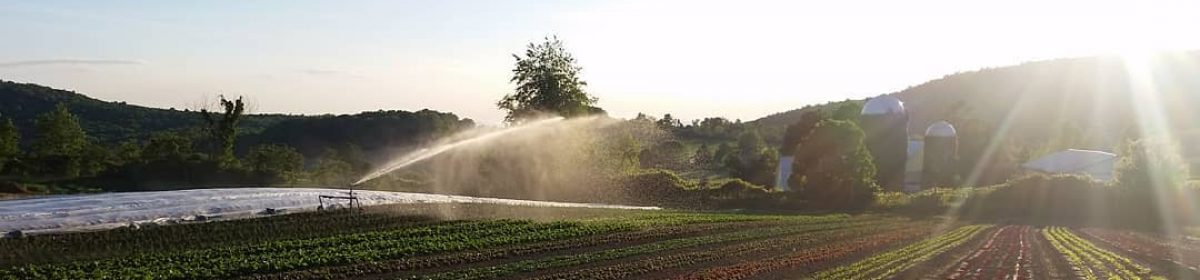
What’s new on the farm. Dry conditions continue to consume all of our attention. Every two or three hours we switch some plumbing or fire up a new pump. The wet weather system predicted for late last week – scattered storms that would deliver heavy rainfall up and down the Hudson Valley – missed us completely. And there is little chance of rain in the current ten day forecast. The walk in to the pond follows a now well-worn path and – the silver lining – it’s a refreshing escape from the sun. The path is the length of a city block and follows along a creek, over logs, through ferns, around fox dens. When I arrive at the pond’s edge, the frogs all jump in. It’s as though the life guard has given the all clear signal to the kids at the community pool. Starting the pump had been a headache, but the new Honda GX390 we installed last year has proven to be a reliable motor and the new cast iron impeller a significant improvement over the cheaper plastic models we’ve used in the past. With all the practice, I have finally learned how to set the choke and throttle so that it starts with a single, gentle pull. Small satisfaction. The middle pond still has plenty of water, but the back pond is now dry, and without rain sometime soon, we’ll start to experience losses. Vegetables are more than 90% water. We are a little desperate here, but are trying to keep up. Northeastern farmers are used to irrigating, but, unlike California’s vegetable farmers, we are unaccustomed to providing all of the water our crops need. We don’t have canals or federal irrigation projects. The farm is getting a little weedy, and we are behind in our plantings, but, so far, we are keeping established crops watered. We will keep you posted. Now, off to climb on the Sherpa – there are two pumps to turn off for the night.

Have a great week, Ted