Distribution #11 – Week of August 17, 2020

The News from Windflower Farm

Greetings from Windflower Farm. Shorter days and cooler nights signal the start of the school year. Our farm staff is smaller by one this week. Mallory, who started here when she was 14, is off to begin her freshman year in college. Two other student workers will leave soon, but their schedules remain hazy. We’ll miss them when they go.

What’s in your share?

  • Sweet corn
  • Tomatoes
  • Basil
  • Peppers
  • Cucumbers (or squash)
  • Cabbage (or eggplant)
  • Lacinato kale (or lettuce)
  • Onions
  • Garlic

What’s new on the farm?

Your basil was greenhouse grown because we were afraid that downy mildew would have killed it in the field. There is more to come. One goal will be to learn how to scale it up so that there is enough in the share for a batch of pesto. Your fruit share will be our own melons.

We have always farmed organically. Passersby know this because our fields are a little weedier than those absolutely weed-free corn fields in our neighborhood. That those fields are made weed-free by applications of a pre-emergent herbicide represent one of the differences between organic and conventional agriculture. We have a number of good tools in our weed management toolbox, but none are as effective as the herbicides used by my neighbors, and I find myself at times to be a little envious. In the past, we had worked with a group called Certified Naturally Grown for our organic certification. This year, we switched teams so that we would be certified under the national rule, which is more widely accepted, and we received our new certificate in the mail this week.

One of the key differences under this new rulebook is that so-called biodegradable plastic mulches are not allowed. It is suspected that they contain petroleum additives that are not good for soil health despite their use in Canadian and European organics. Only truly plastic mulches can be used in the states, and we’ll have to send any plastic mulches we do use to a landfill when we’re finished with them. This will certainly motivate us to try to eliminate those products altogether. Another key difference is that the paper trail required to enable a bonafide third party audit of an organic farm is substantial, and participation in the process has required us to make some changes to our record keeping system. Both of these changes – reducing the use of plastics and keeping better records – will make us a better farm business.

This week, we’ll wrap up our yellow onion harvest and begin on reds and shallots, vegetables that I enjoy growing and that our farm seems well suited to. Which brings me to a subject we are thinking out loud about. We have begun talking with other CSA farmers in the region about taking a more collaborative approach to producing what goes into your weekly shares. For the twenty years we have been a CSA, we have grown almost everything that we have sent. But we have come to believe that your shares (and our work lives) might be enhanced with a little selective vegetable crop swapping.  

To that end, we are considering working with a small handful of experienced (and certified) organic farmers who would provide us with the kinds of vegetables that they grow particularly well, and we, in turn, would grow more of the kinds of crops that we do well and send those to their CSA members. We might grow more onions or tomatoes or squashes, for example, and trade them for early carrots or cucumbers or summer lettuce. In this way, we might more reliably offer to our CSA membership more of those vegetables that are difficult for us to grow. The benefit for us is that we’d eliminate a few challenging crops, enabling us to grow more of those vegetables we grow well. I share this because I’m curious to know what you think about this idea. Please feel free to drop me a line.

Have a great week, Ted 

Distribution #10 – Week of August 10, 2020

The News from Windflower Farm

Hello from Windflower Farm. Last Tuesday’s tropical storm, Isaias, dropped just over three inches of rain here, replenishing both of our ponds in dramatic fashion (see our Instagram page) and giving our farm it’s very first all-day rain of the season. I know that in New York you were battling high winds and heavy rains on that day, and I stayed in close touch with our delivery team to hear how things were playing out, but I also had the first deep rest in a long while that afternoon, knowing the good that a much reduced Isaias was delivering to our little farm. We are irrigating now from a pond that was bone dry just a week ago.

What’s in your share?

  • Swiss chard
  • Toscano kale
  • Tomatoes
  • Peppers
  • Cucumbers on Tuesday, squashes on Thursday
  • Beets
  • Sweet corn
  • Onions
  • Garlic

Your fruit share will be peaches from Yonder Farm

What’s new on the farm?

Bill McKibbon wrote recently that, at current levels, warming is happening at a rate that can be likened to moving south 12 miles every year. As a farmer, I imagine ten years of this, and then twenty. I’ll be farming in a lower Hudson Valley climate soon, and then in South Jersey’s. The corn, tomato and squash season will be four weeks longer, and then eight. We’ll be growing peaches and red, seedless table grapes. And then I think of the heat. Already Jan threatens to leave here, searching for a more hospitable climate – coastal Newfoundland, perhaps, or Reykjavik, which she hears is nice. And I think of the concern a fruit grower shared with me: warm early springs, which result in early blooms, coupled with occasional spring freezes that threaten an early crop, actually make peach and plum crops far less reliable as the world warms. And I think of the flooding along the coasts and the dislocation of millions of people.

When we work the soil, CO2 is released, making organic farmers complicit in the largest contribution farmers as a whole make to greenhouse gas emissions. Planting kale or lettuce or carrots requires a nearly perfect bed, which requires tillage. But when we plant a sod, sow cover crops or replant woodlands, we can, on the other hand, sequester carbon. Minimizing carbon-burning tillage and maximizing steps that help sequester carbon are two of the most promising steps we can take toward slowing the warming of our planet, and at Windflower Farm there is much more we can do along these lines.

Some scientists believe that agriculture can be made carbon-neutral with perennial crops, reduced tillage, management-intensive grazing and agroforestry, among other things. We’ll be a while in achieving this, but I am heartened when I attend conferences and see so many young farmers attending sessions on reducing tillage and soil health. The tool I’m saving for is a roller/crimper. It rolls a cover crop down, turning it into a weed-suppressive mulch, into which we can transplant all kinds of vegetable crops without any kind of tillage at all. Next year, I hope to be able to report that your sweet corn and broccoli and ‘Delicata’ squash were grown using reduced tillage practices.

Best wishes, Ted

Distribution #9 – Week of August 3, 2020

The News from Windflower Farm

August greetings from all of us at Windflower Farm.

What’s in your share?

  • Lettuce
  • Koji on Tuesday, cabbage on Thursday
  • Tomatoes
  • Sweet corn
  • Green beans
  • Onions or scallions
  • Summer squashes or zucchinis
  • Sweet peppers

The share list that I provide at the top of each newsletter is not to be taken verbatim. It’s my educated guess about what should be ready in adequate supply and of a quality that is good enough to send to you that week. But I’m generally making this guess a couple of days ahead of the actual harvest, and it’s harder than you might think to get this right. Heat can cause bolting in virtually all of the greens, and insects can render them inedible overnight. And getting precise counts of eggplants or peppers or cucumbers is just not practical. And so, if we run out of the eggplants we promised, we might substitute peppers or cucumbers or cabbage. They say that a little mystery is good for a relationship.

What’s new on the farm?

A light rain is falling as I write this. The greens seeder is mounted on the John Deere and I’d like to sow a round of arugula, chard, kale and cilantro into beds I prepared yesterday. Our greens production has suffered lately, and I’m hoping to get it back on track. It has been so dry that a little rain won’t be a problem for the seeder. In fact, it has been so hot and dry that It’s been difficult to get some of our crops established. Most vegetables seeds, and all of the seeds that produce greens, are small, and they generally can’t be seeded more than half an inch deep. And evaporative water loss from the top half inch of soil has been a big problem for us this year. A strategy that has proven successful in getting our carrots established (after two previous attempts) has now become common practice here. Immediately after seeding, we set up runs of micro-sprinklers, called Mini-Wobblers, along the entire length of the new planting and run them for an hour every other day until the crop comes up. The sprinklers come from a company that got its start in Florida, where they know how to deal with heat. According to the brochure, “they replicate a light summer rain shower and keep the seeds bathed in moisture throughout their germination and emergence.” So, once I manage to get these greens seeded, I’ll ask the guys to help me move the Mini-Wobblers into place, and I’ll leave them there until I see nice little rows of greens getting off to a good start.     

Have a great week, Ted   

Distribution #8 – Week of July 27, 2020

The News from Windflower Farm

Hello from a hot and humid Windflower Farm, where tomorrow’s heat index is supposed to be over 100 degrees Fahrenheit!

What’s in your share?

  • Lots of tomatoes
  • Zucchini or Zephyr squash
  • Sweet peppers
  • Eggplant
  • Kale on Tuesday, collards on Thursday
  • And more

Your fruit share will be Yonder Farm’s blueberries or peaches. Pete says it’s most likely to be blueberries.

This year’s flower share was just six weeks long. The shorter flower season was designed to give Jan a chance to undertake new projects this summer. The share wrapped up at some locations in week #6 and at most locations last week, which was week #7. It comes to an end for the last two sites this week. We’ll miss having all those lovely flowers everywhere – greenhouse, fields, packing shed.

What’s new at the farm?

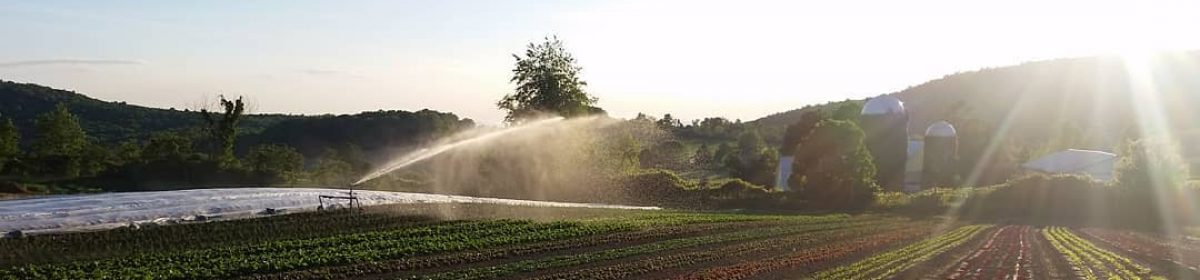
It’s Sunday morning. Jan has just finished harvesting flowers – her last of the season – and is now cleaning up one of her flower fields. Nate is mowing. Heidi, a nurse and friend who stops over every now and again for “weeding therapy,” is in the carrots. And the Medina family, working as a group, as always, are harvesting tomatoes, peppers, cabbages and squash. It is the tail end of a hot July, the dog days here in the Hudson Valley, and the work starts early to avoid the heat. I’m on irrigation duty. The pepper and tomato tunnels in our front field ran from 6:00 to 8:30 am (Jan, an early bird, actually turned those on). I’ve got the carrots running now and I’ll let them run until just before the lunch hour, after which it’s on to the red and yellow onion block, followed by a block of eggplants, chiles and peppers. All of this water is coming from a well that is 470’ deep and delivers nearly 100 gallons per minute.

Nate is on irrigation duty tomorrow. He’ll use the back pond to irrigate the squashes, cucumbers and melons in the back fields, all of which are mulched and on drip irrigation. He’ll then irrigate the back tomato, ginger and pepper tunnels. He thinks that the pond will be empty when he’s done with this round of irrigating, leaving just enough for the snappers and frogs and water bugs to carry on their lives. We’ll need to tap into the newest well if we are to irrigate those fields again. He’ll run the drip system on the sweet potatoes in our big field, too, but using our bigger pond in this case, which seems to still have a fair amount of water. And if he has time, he’ll use a tractor-mounted tool he fabricated to lay out drip tape on a block of cabbages in the big field and then run them for a couple of hours. We like to keep Nate busy.

In a hot, dry season, few vegetables will give good results without irrigation, and even irrigation won’t help if it’s too hot. You’ll get our unirrigated corn soon and see what I mean. The flavor and texture will be good, but the “fill” will be poor. Broccoli and lettuce becomes bitter in the heat, and no amount of irrigation seems to remedy that. In the case of broccoli, the bitter compound is glucosinolate, and it can be leached out to some extent by boiling in salt water, the downside of which is that it probably also pulls nutrients out of the vegetable. We have planted more of both and hope they will be sweeter with the return of cooler weather.

We have quite a bit to do this week besides irrigating. Tomorrow, we’ll pick up some row covers and till under old crop and weed residues. It’s time to think about seeding down cover crops in fields we’ve finished using for the season. We’ll sow oats and peas if it’s early enough and a mix of rye and vetch a little later. We spread compost and some other soil amendments on a couple of fields last week and we’ll continue to transplant fall greens and more Cucurbits and to field-sow spinach and salad greens. We’ll try to find time to use the old G tractors to cultivate the radishes, arugula, turnips and lettuces. And we’ll go through the sweet potatoes and melons one more time before the vines run, taking out the weed escapes by hand. And we’ll make time for siestas, because these are the dog days, and it’s hot outside.

Have a great week, Ted

Distribution #7 – Week of July 20, 2020

The News from Windflower Farm

Hello from a hot Windflower Farm!

What’s in your share?

  • Fennel bulbs and fronds
  • Scallions
  • Eggplant
  • Zucchinis or summer squashes
  • Green Boston lettuce
  • Kale or collards
  • Onion bulbs
  • Broccoli, broccolini or beets

Your fruit share will be blueberries from Yonder Farm. Peaches, plums and apricots are coming soon.

Peppers have also been coming along quickly and may be a part of next week’s share. Beans are likely, too.

Our eggplant harvest came as a bit of a surprise for us this week – the hot weather and drip irrigation have helped to bring it along sooner than expected. If you are relatively new to eggplant, you might try it on your pizza: slice it, dip it in a light batter, and fry it on the stove top. Put the fried eggplant slices on top of your favorite pizza and add dollops of pesto and ricotta. Baba ganoush, ratatouille and Thai spicy eggplant with basil are other excellent options. 

Fennel bulbs and fronds are also in your shares. Curried roasted fennel, summer slaw and shaved fennel salad are great ways to enjoy this vegetable. 

All of these recipes and many more can be found at the Stanton Street CSA website (https://stantonstreetcsa.wordpress.com) under “Veggie tips & recipes.” We also like contentednesscooking.com for recipe ideas.

We experimented with packing everything into one bag at a few sites last week, and the results were not what we wanted. This week, your shares will come in three packages: two smaller plastic bags – one containing greens and the other the more durable vegetables – and a paper bag full of tomatoes. And they will be shipped to sites in separate totes. Remember, there will be no box (except locally and at the park site in Washington Hts.), so you’ll need something in which to carry these items home.

What’s new on the farm?

Our organic certification inspector is coming on Tuesday. Farm inspections are an annual event, but this is our first with this organization. We’ve been busy getting our paperwork in order, putting soil tests in a file, cleaning up our workshop, tidying up our barns and seed cupboard, tackling weed messes and generally trying to make ourselves appear respectable. 

The inspector, a woman from the western Catskills, will come with two activities in mind. In the “mass balance audit” she’ll take a look at all of our purchases (seeds, plastics, etc.), field applications (compost, lime), field plantings and harvest records and ask if this is enough to support our sales volume or what we have noted on our CSA distribution lists. In the “trace-back audit” she’ll select an item from the distribution record and follow it back through time from distribution to harvest and planting, looking at field maps, seeding records and the purchase of associated inputs. It could be a long day.

Wish us luck, and have a great week!

Cheers, Ted